8 Blazing Fast Security Analysis Tools That Move at the Speed of Light
8 Blazing Fast Security Analysis Tools That Move at the Speed of Light
Why a Fast Penetration Testing Service Is No Longer Optional in 2026
A fast penetration testing service is the difference between catching a vulnerability before attackers do — and finding out the hard way. If you need a quick answer, here are the top options worth evaluating:
| Service | Turnaround | Best For |
|---|---|---|
| Aman Security | Minutes | AI-powered, free scans, DevSecOps |
| Aikido Attack | Hours | Developer-first, auto-remediation |
| Cobalt.io | 24-hour start | PTaaS, compliance, enterprise |
| XBOW Lightspeed | 5 business days | Autonomous agents, PoC exploits |
| Pentest-Tools.com | Same day | Workflow automation, MSPs |
| Beagle Security | Continuous | CI/CD integration, API security |
| BreachLock | On-demand | Hybrid PTaaS, SOC 2 / ISO 27001 |
| Pentera | Scheduled | Enterprise network simulation |
Traditional penetration testing takes weeks. Scoping calls, scheduling, manual testing, report writing — the average engagement can stretch to 30 days or more. During that time, your vulnerability window stays wide open.
The problem is real. Security teams at fast-moving startups and scale-ups can’t afford to wait. They’re shipping code daily, integrating new APIs, and spinning up cloud infrastructure — all while trying to stay compliant with SOC 2, ISO 27001, or HIPAA.
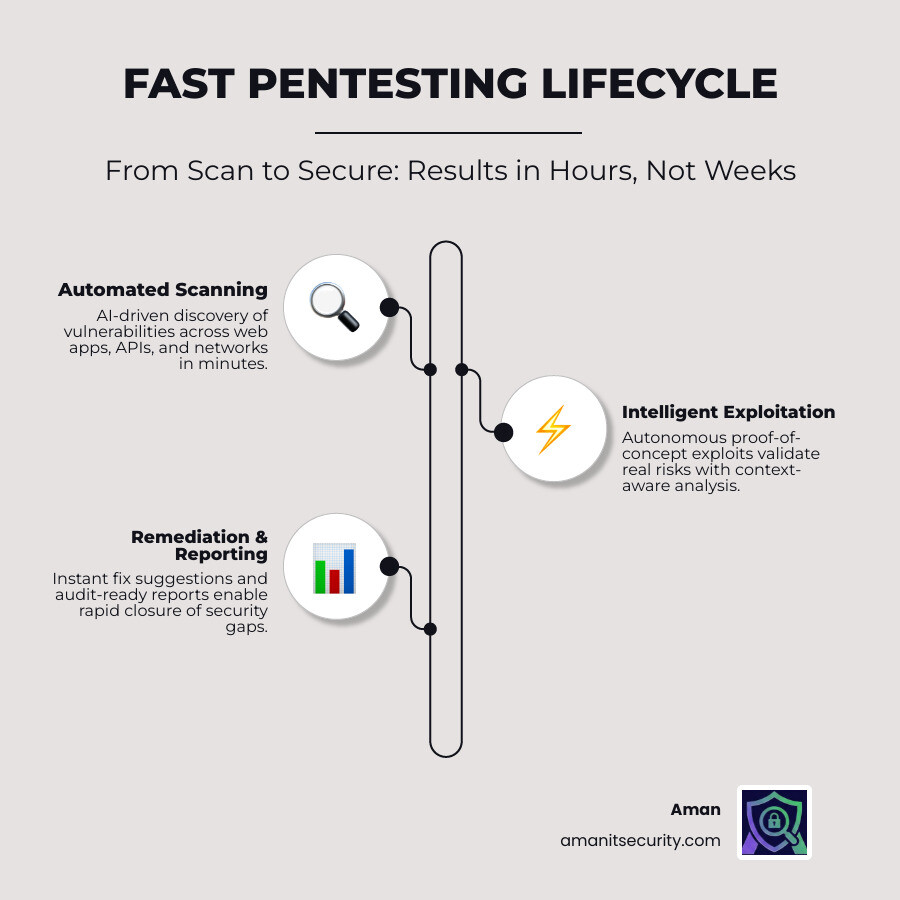
Modern fast pentesting tools change the equation entirely. AI-powered platforms and Penetration Testing as a Service (PTaaS) models now deliver results in hours or days, not weeks — with proof-of-concept exploits, audit-ready reports, and CI/CD integrations included.
The cost difference is just as striking. Traditional manual tests typically run between $5,000 and $50,000. Some fast services now start at a fraction of that — making professional-grade security testing accessible even for resource-constrained teams.
I’m Zezo Hafez, an AWS and Azure certified IT Manager with over 15 years of experience in web development and cloud security, including hands-on work evaluating fast penetration testing service solutions across multi-cloud and hybrid environments. In this roundup, I’ll walk you through the eight tools that genuinely deliver on the promise of speed without sacrificing depth.
What Defines a Modern Fast Penetration Testing Service?
In the old days of cybersecurity (which, in tech years, was about three years ago), a “fast” pentest meant the consultant sent you a PDF in ten days instead of twenty. Today, speed is driven by three pillars: Automation, AI-powered reasoning, and the Penetration Testing as a Service (PTaaS) model.
A modern fast penetration testing service doesn’t just scan for open ports; it understands context. While a standard vulnerability scanner might tell you a port is open, a fast pentesting tool will attempt to exploit it, prove the risk, and provide a remediation path—all before a human consultant could even finish their first cup of coffee.
This shift is essential for Web Applications Penetration Testing, where code changes happen hourly. By integrating directly into DevSecOps workflows and CI/CD pipelines, these services provide real-time reporting that keeps pace with development.
Traditional vs. Fast Pentesting: The Breakdown
| Feature | Traditional Pentesting | Fast Pentesting Service |
|---|---|---|
| Wait Time | 2–4 weeks for scheduling | Instant or < 24 hours |
| Methodology | Manual-heavy, point-in-time | AI-augmented, continuous |
| Reporting | Static PDF (often weeks later) | Real-time dashboard + instant PDF |
| Integration | None (manual ticket entry) | Native Jira, Slack, GitHub |
| Cost | High ($5k – $50k) | Flexible (Free to $8k/test) |
| Compliance | Annual check-box | Continuous audit-readiness |
Top 8 Tools for a Fast Penetration Testing Service
When we look for the best tools, we aren’t just looking for “scanners.” We are looking for platforms that simulate real-world attacks, validate findings with evidence, and scale with your business.
1. Aman Security: The Leader in AI-Driven Speed
At Aman Security, we believe that security should move as fast as your developers. We’ve built a platform that combines AI-powered automated penetration testing with deep SAST analysis and vulnerability scanning.
What makes us different? We offer free scans that don’t just dump a list of “low/medium/high” risks on your desk. Our engine provides instant AI explanations for every finding. If we find a flaw, we tell you exactly why it matters and—more importantly—give you the specific fix suggestions to close the hole immediately.
As highlighted in our guide on The Best AI Penetration Testing Tools for 2026, our focus is on high-speed, pro-grade reports that are ready for management or auditors the moment the scan finishes. It’s about removing the “security bottleneck” entirely.
2. Cobalt.io: Scaling with PTaaS
Cobalt.io pioneered the Pentest as a Service (PTaaS) model. They don’t just use bots; they use a crowdsourced community of vetted researchers (the Cobalt Core) supported by a powerful SaaS platform.
- Speed Factor: Cobalt enables you to start a test in as little as 24 hours.
- Efficiency: They boast 2.6x faster time to report than traditional approaches and get teams to remediation 50% faster.
- Agile Security: Because it’s a platform, your developers can talk directly to the testers in a specialized UI, skipping the “email tag” that usually slows down fixes.
The Cobalt.io platform is a favorite for enterprises that need the human touch of a manual test but the speed of a modern cloud workflow.
3. XBOW Lightspeed: Autonomous Agentic Security
XBOW Lightspeed is for those who want “expert-level” results without the expert-level wait times. They utilize autonomous AI agents that act like a human pentester—exploring, reasoning, and attacking targets.
- Turnaround: While the agents work fast, the full compliance-ready report is typically delivered within 5 business days.
- Proof of Risk: One of XBOW’s standout features is the delivery of actual Proof-of-Concept (PoC) exploits. They don’t just say you’re vulnerable; they show you the “receipts.”
- Trust: They have received verified feedback from enterprise security teams for their ability to meet SOC 2 and ISO 27001 requirements autonomously.
4. Pentest-Tools.com: Workflow Automation
If you are a security consultant or an MSP (Managed Service Provider), Pentest-Tools.com is likely already in your bookmarks. It’s a comprehensive cloud platform that automates the “boring” parts of pentesting.
- Pentest Robots: These are automated sequences that chain multiple tools together (like subdomain discovery followed by port scanning and vulnerability detection).
- Reporting Speed: They can generate editable DOCX reports 90% faster than manual methods. You can even view sample reports to see the professional formatting.
- Attack Surface Mapping: It’s excellent for finding “shadow IT”—those forgotten servers your marketing team spun up three years ago that are now a massive security risk.
5. Aikido Attack: Developer-First Fast Penetration Testing Service
Aikido Attack is built for the “shift left” movement. They focus heavily on removing the noise that plagues traditional scanners.
- Zero False Positives: Aikido only reports findings that it has successfully exploited and validated. This is a massive time-saver for developers who are tired of chasing “ghost” vulnerabilities.
- Speed: They can deliver a full pentest in just 2 hours, which is unheard of in the traditional consulting world.
- Scientific Backing: Their approach aligns with Scientific research on cybersecurity audit effectiveness, ensuring that frequent, automated testing actually leads to a better security posture.
- Auto-Remediation: In many cases, they provide “AutoFix” pull requests, allowing you to fix a bug with a single click.
6. Beagle Security: Agentic AI for DevSecOps
Beagle Security is making waves with its “Agentic AI.” This isn’t just a basic script; it’s an autonomous system that mimics human decision-making to explore attack paths.
- CI/CD Native: It is designed to live inside your pipeline, triggering a scan every time you push code.
- API Security: As businesses move toward microservices, Beagle’s focus on REST, GraphQL, and gRPC security becomes a major advantage.
- 2025 Trends: They are at the forefront of the 2025 trend where AI doesn’t just find bugs but actually prioritizes them based on business impact, ensuring your team works on the “scary” stuff first.
7. BreachLock: Hybrid Speed
BreachLock offers a “best of both worlds” approach by combining AI, automation, and human expertise into a single PTaaS platform.
- Compliance-Ready: They are heavily focused on helping companies meet SOC 2, ISO 27001, HIPAA, and PCI DSS 4.0.
- Scalability: Whether you need to test one web app or an entire global network, their platform allows you to scale up testing on-demand without hiring a dozen new contractors.
- Speed: By using automation for the initial heavy lifting, their human testers can focus on complex logic flaws, delivering a deep report much faster than a purely manual shop.
8. Pentera: Enterprise Network Simulation
While many tools on this list focus on web apps, Pentera is the heavyweight champion of the internal network.
- Safe Exploitation: Pentera safely exploits vulnerabilities in your live network environment to show exactly how an attacker could move laterally from a receptionist’s laptop to your sensitive database.
- Automated Validation: It replaces the need for quarterly manual network pentests by providing continuous, automated validation of your security controls.
- Impact Analysis: Instead of a list of 500 “High” vulnerabilities, Pentera shows you the specific attack path an adversary would take, allowing you to block the entire path by fixing just one or two key issues.
Benefits and Limitations of Rapid Security Analysis
Moving at the speed of light sounds great, but is there a catch? Let’s look at the trade-offs.
The Benefits
- Cost-Effectiveness: As we’ve seen, you can get a fast penetration testing service for as little as $495 (for startups) or even Free with Aman Security. This allows for frequent testing rather than a once-a-year “event.”
- Closing the Window: Attackers use automation to find you. If you aren’t using automation to find your own flaws, you’re playing a losing game. Rapid analysis helps you How to Mitigate SQL Injection Vulnerabilities before they are exploited.
- Startup-Friendly: For a company with five employees, spending $20k on a pentest is impossible. Fast services provide the compliance reports needed to close big enterprise deals without breaking the bank.
The Limitations
- Business Logic Gaps: AI is getting smarter, but it still struggles with complex business logic. For example, an AI might find a SQL injection, but it might not realize that a user shouldn’t be able to “refund” themselves more money than they spent.
- The Need for Synergy: The best security posture uses a “Fast + Deep” approach. Use a fast penetration testing service weekly or monthly, and supplement it with a deep manual human-led test once a year.
- False Positive Prevention: While tools like Aikido and Aman focus on validation, some lower-tier automated tools can still “hallucinate” or report issues that aren’t actually exploitable in your specific environment.
Frequently Asked Questions about Fast Pentesting
Is a fast penetration testing service as reliable as manual testing?
For 90% of vulnerabilities (OWASP Top 10, misconfigurations, known CVEs), yes. AI-driven tools are often more consistent than humans because they don’t get tired or miss a step on a Friday afternoon. However, for “creative” hacking—like chaining three minor logic flaws to achieve a major breach—human expertise is still the gold standard. The most reliable services use AI-validation and exploit confirmation to ensure accuracy.
Which compliance standards do these fast services support?
Most top-tier fast pentesting services provide reports that are specifically formatted for auditors. This includes:
- SOC 2 Type I & II
- ISO 27001
- HIPAA
- GDPR
- PCI DSS 4.0 These reports typically include an attestation letter, a summary for management, and detailed technical evidence for the audit trail.
How much does a fast pentest typically cost?
The pricing has become much more transparent in recent years:
- Free: Aman Security offers free scans with AI explanations.
- Startup/Basic: Services like Fast Pen Tests start around $495.
- Mid-Market/Standard: AI-driven tests from Aikido or XBOW start between $960 and $4,000.
- Enterprise/PTaaS: Subscription models or deep network tests like Pentera can range from $10,000 to $35,000+ annually, which is still often cheaper than multiple manual tests.
Choosing the Right Fast Penetration Testing Service for Your Team
Choosing a service comes down to your “Security Maturity.”
If you are a developer-heavy team shipping code daily, look for a tool that integrates into your CI/CD and offers auto-remediation (like Aikido or Beagle). If you are a CISO at a regulated firm, you likely need a PTaaS platform that combines speed with human oversight (like Cobalt or BreachLock).
If you’re just starting out or want to see where you stand right now, we invite you to try our platform. We provide the speed of AI with the depth of a professional report—all without the “enterprise” price tag. You can even learn about advanced techniques like Generative AI Penetration Testing Prompt Engineering for Pentesters on our blog to see how we stay ahead of the curve.
Ready to close your vulnerability window? More info about Aman Security services is just a click away. Don’t let a “slow” security process be the reason you make the headlines for the wrong reasons.
Secure Your Apps with Aman
Put these mitigation steps into practice. Get professional-grade vulnerability detection in one place.
Launch Your First Scan Now