The No-Nonsense Guide to Using AI for Penetration Testing Success
The No-Nonsense Guide to Using AI for Penetration Testing Success
Why Using AI for Penetration Testing Is Changing Cybersecurity Forever
Using AI for penetration testing means deploying artificial intelligence and machine learning to automatically discover, validate, and exploit security vulnerabilities — at a speed and scale no human team can match alone.
Here’s a quick snapshot of what that looks like in practice:
| What AI Does in Pentesting | Why It Matters |
|---|---|
| Runs hundreds of attack agents in parallel | Completes in hours what takes humans weeks |
| Continuously scans for new vulnerabilities | No gaps between annual or quarterly tests |
| Validates exploits before reporting | Dramatically reduces false positives |
| Targets AI-specific flaws like prompt injection | Covers attack surfaces legacy tools miss entirely |
| Generates remediation guidance automatically | Speeds up the fix cycle for dev teams |
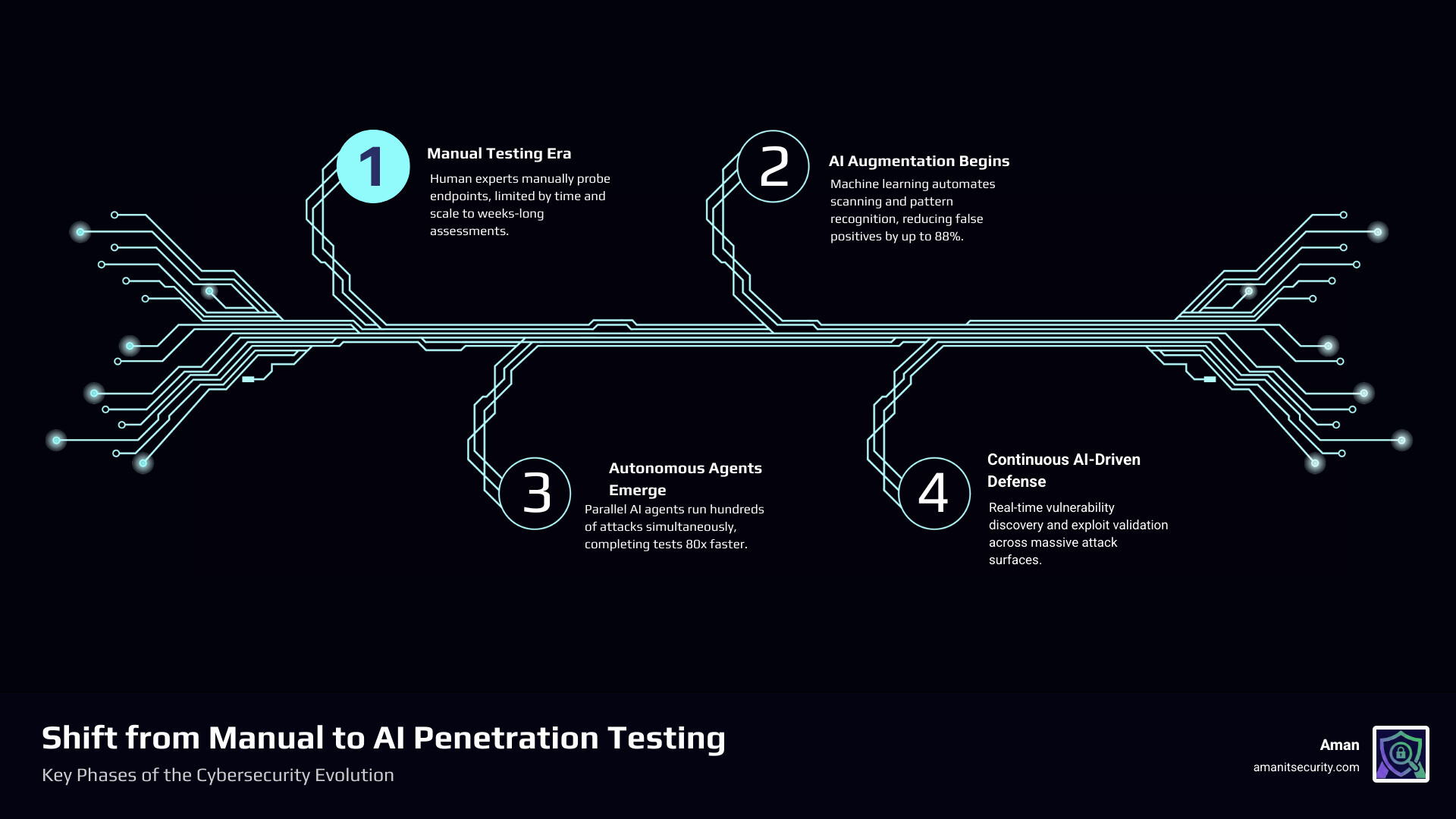
Manual penetration testing has always been slow, expensive, and limited by human bandwidth. A skilled tester can only probe so many endpoints in a given week. Meanwhile, attackers are using automation to scan thousands of targets simultaneously.
The gap is widening — and fast.
AI-powered platforms are now completing full security assessments up to 80 times faster than traditional manual methods, with some demonstrating up to 88% reductions in alert noise compared to conventional tools. That’s not a marginal improvement. That’s a fundamental shift in how security testing works.
For DevSecOps teams juggling CI/CD pipelines, compliance deadlines, and lean budgets, this shift isn’t optional — it’s a survival strategy.
I’m Zezo Hafez, an AWS and Azure certified IT Manager with over 15 years of experience in web development and cloud security, and I’ve seen how using AI for penetration testing transforms what security teams can realistically achieve. In the sections ahead, I’ll walk you through everything you need to know — from the core concepts to the tools, techniques, and best practices — so you can put AI to work in your own security program.
What is AI Penetration Testing and Why It Matters
At its core, AI penetration testing is a specialized form of ethical hacking that uses Large Language Models (LLMs) and machine learning to identify and exploit vulnerabilities. While traditional penetration testing relies on a human expert manually running tools and scripts, AI-driven testing uses autonomous agents that can “reason” through an attack path.
Traditional methods often struggle with the sheer size of modern digital footprints. Between cloud environments, microservices, and shadow IT, the attack surface is simply too large for a human to map out every single day. This is where the NIST SP 800-115 Technical Guide comes into play, providing a framework for technical security testing that AI is now helping to automate.
Why does this matter? Because the bad guys aren’t waiting for your annual audit. They are using AI-powered cyberattacks to find holes in your perimeter 24/7. If you aren’t using similar technology to defend yourself, you’re bringing a knife to a laser-gun fight. We’ve previously discussed how infrastructure vulnerability assessment tips essential to a modern defense include moving toward more frequent, automated checks.
Traditional Pentesting vs. AI-Powered Pentesting
| Feature | Traditional Pentesting | AI-Powered Pentesting |
|---|---|---|
| Frequency | Annual or bi-annual | Continuous or on-demand |
| Speed | Weeks to schedule and execute | Minutes to hours |
| Scope | Sample-based (limited) | Comprehensive (full environment) |
| Consistency | Varies by tester skill | Highly standardized |
| Cost | High ($10k – $50k+ per test) | Low (often subscription or free) |
Core Benefits of Using AI for Penetration Testing
The most immediate impact of using ai for penetration testing is the sheer velocity of the work. Research shows that AI-powered testing can be 80x faster than manual methods. Imagine a scenario where a new zero-day vulnerability is announced; a human team might take days to coordinate a scan across all your assets, but an AI system can pivot and check your entire infrastructure in an afternoon.
Another massive benefit is scale. Modern AI frameworks can deploy hundreds of parallel “agents”—essentially digital clones of a pentester—to work on different parts of your network simultaneously. This is backed by scientific research on Multi-Agent Penetration Testing AI for the Web, which highlights how these agents coordinate to find complex attack chains that a single scanner would miss.
We also see a significant improvement in the role of automated security tools when AI is involved. It’s no longer just about finding a “potential” bug; it’s about validating it.
Scaling Offensive Security with Autonomous Agents
When we talk about autonomous agents, we aren’t just talking about a script that runs a list of commands. We are talking about “Agentic AI” that can:
- Perform Reconnaissance: Scour the web and your network for open ports and exposed data.
- Plan the Attack: Decide that “Vulnerability A” can be used to gain the credentials needed for “Vulnerability B.”
- Execute and Validate: Actually attempt the exploit in a safe way to prove it’s real.
This machine-speed execution allows for 24/7 testing. While your security team is sleeping, your AI agents are hunting for the latest configuration drifts or unpatched services.
Improving Accuracy in Using AI for Penetration Testing
One of the biggest headaches in cybersecurity is “alert fatigue.” Traditional scanners often flag “vulnerabilities” that aren’t actually exploitable in your specific environment. AI helps solve this by using pattern recognition to filter out the noise. According to SANS Institute’s research on false positives, reducing these “ghost” issues is critical for team morale and efficiency.
AI systems like the ones we use at Aman don’t just say, “You have a SQL injection.” They attempt to validate the exploit and provide a “proof of concept” (PoC). If the AI can’t prove the vulnerability is real, it doesn’t waste your time with a report. This leads to an 88% reduction in alerts compared to legacy tools, allowing your developers to focus on fixes that actually matter.
Unique Vulnerabilities Targeted by AI Pentesting
As organizations adopt more AI tools themselves, they create a new kind of attack surface. Standard scanners are great at finding old-school bugs like SQL injection, but they are often blind to “AI-native” threats. Using ai for penetration testing allows you to target these modern risks:
- Prompt Injection: Tricking an LLM (like a chatbot) into ignoring its safety instructions to leak data or execute commands.
- Data Poisoning: Corrupting the training data of an AI model so it makes biased or dangerous decisions.
- Model Evasion: Slightly modifying an input (like an image or a file) so an AI security filter fails to recognize it as malicious.
- Model Inversion: “Reverse engineering” a model to extract the sensitive data it was trained on.
By following the OWASP Web Security Testing Guide (WSTG), AI pentesters can apply these advanced techniques to modern web apps. For a deeper dive into the basics, check out our guide on web applications penetration testing.
Securing the LLM Lifecycle
Security doesn’t stop at the code level. You have to secure the entire lifecycle of the models you use. This includes API security (how your app talks to the AI) and preventing “Model Theft.” The OWASP Top 10 for LLMs is the new gold standard here.
Integrating these checks into your development pipeline is essential. If you’re building mobile interfaces for your AI, you’ll want to know how to implement SAST for mobile apps without losing your mind to ensure the “plumbing” of your app is as secure as the AI itself.
The Hybrid Model: Balancing Automation and Human Expertise
Despite the hype, AI isn’t a “magic button” that replaces humans. While AI is amazing at finding patterns and running 500 tests at once, it often lacks “business logic” awareness.
For example, an AI might find a way to bypass a payment screen. It knows it can do it, but it might not understand the financial impact or the specific regulatory context of your industry. This is where the human comes in. Deloitte’s AI security report emphasizes that the most successful security programs use a hybrid model: AI for the heavy lifting and humans for creative attack chaining and strategic decision-making.
You can explore how different tools handle this balance in our review of 3 ai security audit tools that will not make you nap.
Best Practices for Using AI for Penetration Testing Success
To get the most out of using ai for penetration testing, we recommend these four pillars:
- Asset Inventory First: You can’t test what you don’t know exists. Use AI to discover “Shadow IT” before you start your pentest.
- Shift Left: Don’t wait until your app is in production. Integrate AI-powered SAST and pentesting into your CI/CD pipeline so you find bugs while you’re still writing the code.
- Continuous Testing: Move away from the “once-a-year” mindset. If you push code every day, you should test every day.
- Follow Standards: Align your testing with frameworks like ISO/IEC 42001 (for AI management) and NIST’s proactive security guidelines.
Leading Tools and the Future of AI Pentesting
The landscape of tools is changing rapidly. We are seeing a move away from “just another scanner” toward “orchestration platforms.” These platforms don’t just find a bug; they coordinate a dozen different tools (like Nmap, Burp Suite, and Metasploit) to act like a single, coordinated attacker.
The future of using ai for penetration testing includes:
- Predictive Threat Intelligence: AI that predicts where your next vulnerability will appear based on your coding habits.
- Autonomous Exploit Generation: Systems that write custom, one-time exploits to prove a vulnerability exists without crashing the system.
- Auto-Remediation: Tools that not only find the bug but also open a Pull Request with the fix already written.
If you’re overwhelmed by the options, our ultimate guide to choosing an ai sast analysis tool can help you narrow down the best fit for your stack.
Frequently Asked Questions about AI Pentesting
Will AI eliminate penetration testing jobs?
No, but it will change them. AI acts as a “force multiplier.” It handles the boring, repetitive tasks (like scanning 10,000 ports), allowing human pentesters to focus on high-level strategy, complex business logic, and creative social engineering. The “grunt work” of pentesting is being automated, but the “art” of it still requires a human brain.
How frequently should AI systems be penetration tested?
Because AI models and the threats against them evolve so fast, we recommend continuous testing. At a minimum, a deep dive should happen quarterly or whenever a major change is made to the model or its data sources. Compliance standards like ISO 42001 are increasingly making frequent testing a requirement rather than a suggestion.
Is AI pentesting safe for production environments?
Yes, provided you use the right guardrails. Modern AI pentesting tools use “sandboxing” to execute exploits in isolated environments. They also use deterministic exploits—meaning the AI only runs actions that have a predictable, safe outcome—to ensure they don’t knock your services offline. Always look for tools that allow you to set strict “scope enforcement” and rate limits.
Conclusion
Using AI for penetration testing is no longer a futuristic concept—it’s a current necessity. By automating the “discovery” and “validation” phases of a pentest, organizations can finally keep pace with modern attackers.
At Aman Security, we believe in a proactive, strategic defense. We provide AI-powered automated penetration testing and vulnerability scanning that gives you the best of both worlds: the speed of an AI agent and the clarity of a professional report. Our “blazing-fast” scans are free, providing you with instant AI explanations and fix suggestions so you can spend less time worrying and more time building.
The future of cybersecurity is a symbiosis between human creativity and machine scale. Don’t get left behind—start your journey toward a more secure, AI-driven future today.
For more info about Aman services, visit our homepage and see how we can help you secure your infrastructure in minutes, not weeks.
Secure Your Apps with Aman
Put these mitigation steps into practice. Get professional-grade vulnerability detection in one place.
Launch Your First Scan Now