
Why AI Powered Penetration Testing is the New Industry Standard
Why AI Powered Penetration Testing is the New Industry Standard
Why AI-Powered Penetration Testing Is Becoming the New Security Standard
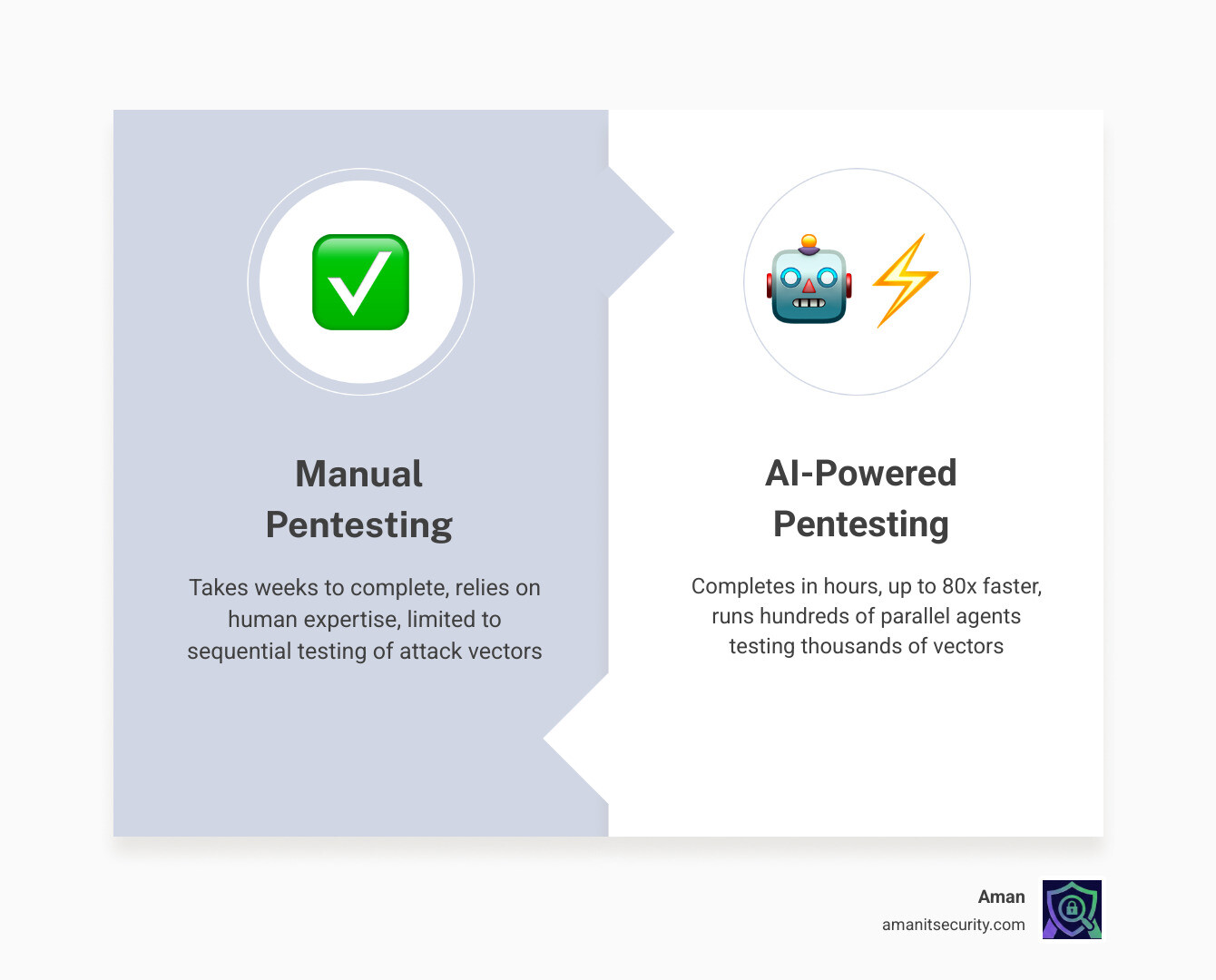
AI-powered penetration testing is the use of artificial intelligence and machine learning to automatically simulate cyberattacks, find vulnerabilities, and validate exploits — often completing in hours what traditional manual testing takes weeks to finish.
Here’s a quick snapshot of what you need to know:
| Question | Quick Answer |
|---|---|
| What is it? | Automated ethical hacking using AI agents to find and validate vulnerabilities |
| How fast? | Hours instead of weeks — up to 80x faster than manual testing |
| Does it replace humans? | No — it augments them, handling repetitive tasks while humans focus on judgment |
| Is it legal? | Yes, with explicit permission from the system owner |
| Who is it for? | DevSecOps teams, security analysts, pentesters, and IT administrators |
| Key tools in 2026 | PentestGPT, Aikido Attack, Mindgard, Garak, NetSPI |
The pressure on security teams has never been higher. Manual vulnerability scanning is slow. Compliance deadlines don’t wait. And attackers aren’t slowing down.
AI changes the math. Platforms can now run hundreds of parallel agents, test thousands of attack vectors simultaneously, and deliver audit-ready reports — all without weeks of back-and-forth scheduling with a human pentester.
One striking data point: a 120-hour human pentest of a real application found zero vulnerabilities. A 2-hour AI pentest of the same application uncovered multiple high-severity issues. That’s not a knock on human pentesters — it’s a signal that AI handles certain tasks at a scale and speed humans simply can’t match alone.
The smartest security teams aren’t choosing between humans and AI. They’re combining both.
I’m Zezo Hafez, an AWS and Azure certified IT professional with over 15 years of experience in web development and cloud infrastructure — and I’ve watched ai-powered penetration testing reshape how organizations approach security from the ground up. In this guide, I’ll walk you through the tools, techniques, and best practices you need to evaluate and adopt AI pentesting confidently.
What is AI-Powered Penetration Testing?
At its core, ai-powered penetration testing is a specialized form of ethical hacking. While traditional pentesting relies on a human expert manually poking at a system’s defenses, AI-driven versions use Large Language Models (LLMs) and autonomous agents to do the heavy lifting. These tools don’t just “scan” for bugs; they think like an attacker, chaining together multiple small flaws to find a path to your crown jewels.

Traditional scanners are often noisy, throwing thousands of “medium” alerts that turn out to be nothing. AI changes this by adding a reasoning layer. It can understand that a small misconfiguration in an API, combined with a weak password policy, leads to a critical data breach. This “contextual reasoning” is why platforms leveraging AI have demonstrated up to an 88% reduction in alert noise compared to traditional tools.
The market reflects this shift. There is currently a $2 trillion opportunity for cybersecurity technology and service providers as organizations scramble to secure their digital assets. We are moving away from “once-a-year” checkups toward continuous, intelligent defense.
The Core Benefits of AI-Powered Penetration Testing
Why are so many companies moving toward these automated solutions? It boils down to four main pillars:
- Speed: AI can complete in hours what would take human teams weeks or months. Some systems are 80x faster than manual methods.
- Scalability: You can test thousands of attack vectors simultaneously across your entire infrastructure—something no human team could ever do.
- 24/7 Monitoring: Unlike a human who needs coffee and sleep, AI agents can provide continuous validation of your security posture.
- Cost Efficiency: By automating the “grunt work” of reconnaissance and scanning, organizations save significantly on billable hours from expensive consultants.
For those specifically looking at code-level security, understanding The Ultimate Guide to Choosing an AI SAST Analysis Tool is a great next step to see how AI integrates into the earlier stages of your development.
Addressing Unique Risks with AI-Powered Penetration Testing
One of the most fascinating aspects of ai-powered penetration testing is its ability to secure AI systems themselves. As we integrate LLMs into our own products, we open up new “weird” vulnerabilities that traditional tools can’t find:
- Prompt Injection: Tricking an AI into ignoring its safety instructions to leak data or execute commands.
- Model Poisoning: Tampering with the data used to train an AI so it behaves maliciously later.
- Adversarial Attacks: Imperceptible changes to inputs (like a few pixels in an image) that cause an AI to misclassify a threat.
To handle these, many modern tools align with the MITRE ATLAS™ framework, which provides a structured way to track and test these AI-specific threats.
| Feature | Traditional Pentesting | AI-Powered Pentesting |
|---|---|---|
| Frequency | Annual or Bi-annual | Continuous / On-demand |
| Speed | 2-4 weeks | Minutes to hours |
| Consistency | Varies by tester skill | Highly consistent |
| Cost | High ($10k – $50k+) | Scalable / Lower entry point |
| Reasoning | Human intuition | LLM-based path reasoning |
Top AI Pentesting Tools in 2026
The landscape is crowded, but a few names consistently stand out for their innovation and reliability.
- PentestGPT: An interactive assistant that guides users through the pentesting process using an LLM-based reasoning engine.
- Aikido Attack: Known for its “agentic” approach, it uses hundreds of parallel agents to find and validate exploits at machine speed.
- Mindgard: A leader in securing AI models themselves against poisoning and extraction.
- Garak: A specialized open-source scanner for LLMs that uses hundreds of probes to find vulnerabilities.
For developers who want to see how these tools fit into a broader strategy, checking out 3 AI Security Audit Tools provides a great overview of the “no-nonsense” options available today. Additionally, frameworks like the Tero open-source framework are helping teams build their own safe AI agents within the software development lifecycle (SDLC).
Key Features of PentestGPT and Aikido Attack
These two tools represent different philosophies in the AI space. PentestGPT acts like a co-pilot. It offers interactive guidance, helping you decide what command to run next based on the output of your previous tool. It’s excellent for education and augmenting a human’s workflow.
On the other hand, tools like Aikido Attack focus on autonomy. They are designed to provide audit-grade reports (suitable for SOC2 or ISO27001 compliance) in record time. They use “exploit validation,” meaning they don’t just report a bug—they actually try to exploit it in a safe environment to prove it’s real, which virtually eliminates false positives.
Setting Up PentestGPT for Success
If you want to get your hands dirty with PentestGPT, the setup is surprisingly straightforward. Here is the general workflow:
- Prerequisites: You’ll need Python 3 installed and an OpenAI API key (GPT-4 is highly recommended for its reasoning capabilities).
- Installation: Most users install via GitHub:
pip3 install git+https://github.com/GreyDGL/PentestGPT. - Environment Variables: You must export your API key so the tool can use it:
export OPENAI_API_KEY='your_key_here'. - Integration: PentestGPT shines when you feed it data from other tools. For example, you can run an Nmap scan, paste the results into the chat, and ask, “What are my next steps based on these open ports?”
The 5 Stages of AI-Powered Penetration Testing
AI doesn’t just “hack”; it follows a logical, structured process that mirrors the five classic stages of ethical hacking.
Automating Reconnaissance and Scanning
In the Reconnaissance and Scanning phases, AI is a force multiplier. It can perform massive asset discovery across your entire attack surface—finding forgotten subdomains, exposed IP addresses, and misconfigured cloud buckets in seconds.
When it comes to Web Applications Penetration Testing, AI tools can analyze Nmap results or Burp Suite logs to identify which services are most likely to be vulnerable. Instead of a human manually checking every version number against a CVE database, the AI does this instantly, prioritizing targets that offer the easiest path to entry.
Exploitation and Reporting at Machine Speed
The “magic” happens during the Gaining Access and Reporting phases. AI agents excel at “vulnerability chaining.” For instance, they might find a low-severity information leak, use that info to guess a username, and then attempt a credential stuffing attack—all in one fluid motion.
To ensure safety, top-tier tools use “hallucination prevention.” They validate every finding by attempting a safe exploit simulation. If the exploit fails, the vulnerability isn’t reported. This results in audit-ready reports that are dense with facts and evidence, rather than guesses. These reports often include remediation guidance—specific code fixes or configuration changes—that developers can apply immediately.
Human-AI Collaboration: Overcoming Hallucinations and Ethics
Despite the hype, we shouldn’t be firing all our human pentesters just yet. AI has “blind spots.” It relies heavily on patterns it has seen before. If a vulnerability requires deep business logic understanding—like knowing that a user shouldn’t be able to “refund” a negative amount to their credit card—AI might miss it.
Why Human Expertise Still Matters
Human intelligence remains essential for:
- Business Logic: Understanding the “why” behind an application’s workflow.
- Creative Problem-Solving: Finding “zero-day” exploits that don’t follow established patterns.
- Risk Prioritization: Deciding which bugs actually matter to your specific business goals.
- Governance: Ensuring that testing remains within legal and ethical boundaries.
The future is a “human-in-the-loop” model. We use AI to handle the 80% of grunt work—scanning, basic exploitation, and drafting reports—leaving the 20% of high-value, complex tasks to human experts. This hybrid approach is how some systems can now predict 85% of cyber-attacks by combining machine speed with human insight.
Best Practices for Enterprise Adoption
If your organization is ready to adopt ai-powered penetration testing, follow these steps:
- Inventory Everything: You can’t protect what you don’t know exists. Start with a full AI and IT asset inventory.
- Shift-Left: Integrate AI pentesting into your CI/CD pipeline. Test every pull request before it ever reaches production.
- Continuous Validation: Move away from “point-in-time” tests. Run automated agents continuously to catch new vulnerabilities as they appear.
- Virtual Patching: Use tools that offer instant “virtual patches” to neutralize threats at the traffic level while your developers work on a permanent code fix.
Frequently Asked Questions about AI Pentesting
Will AI tools replace human pentesters?
No. Think of AI as a power tool. A nail gun didn’t replace the carpenter; it just allowed them to build houses faster. AI acts as a force multiplier, handling the repetitive reconnaissance and scanning while human intuition focuses on complex logic flaws and strategic risk management.
Is AI-powered penetration testing legal and ethical?
Yes, provided you have explicit permission. Pentesting is only legal when performed on systems you own or have written authorization to test. In an enterprise setting, this means working within an authorized scope and ensuring the AI tools follow strict safety guardrails to avoid crashing production systems.
How does AI reduce false positives in security scans?
Traditional scanners report anything that looks like a vulnerability. AI tools add a “validation layer.” They attempt to reproduce the exploit in a sandboxed way. If the AI can’t prove the vulnerability is exploitable, it won’t clutter your report. This can lead to an 85% reduction in noise, allowing teams to focus on real threats.
Conclusion
The era of waiting weeks for a PDF report is over. AI-powered penetration testing has become the new industry standard because it matches the speed and scale of modern software development. By automating the routine and validating the complex, these tools allow security teams to move from a reactive posture to a proactive one.
At Aman Security, we believe in this future. Our platform provides blazing-fast, comprehensive scans with instant AI explanations and fix suggestions. We help you bridge the gap between “finding a bug” and “fixing the risk” without the manual overhead.
Ready to see how AI can transform your security workflow? Strengthen your security with Aman and start your first scan today. The attackers are already using AI—it’s time you did too.
Secure Your Apps with Aman
Put these mitigation steps into practice. Get professional-grade vulnerability detection in one place.
Launch Your First Scan Now