
A Guide to Automating Your Vulnerability Management Workflow
A Guide to Automating Your Vulnerability Management Workflow
Why Modern Security Teams Leverage Vulnerability Management Platforms
The shift toward modern platforms isn’t just a luxury; it’s a survival mechanism. As we’ve seen, the sheer volume of threats is staggering. In 2019, 20,362 new vulnerabilities were identified, an increase of 17.6% over the previous year. Fast forward to 2025, and that trajectory hasn’t slowed down.
Modern security teams face an “impossible backlog.” If you try to fix everything, you fix nothing. This is why how security teams leverage vulnerability management platforms has evolved. It’s no longer about a quarterly PDF report; it’s about real-time risk reduction.
The True Cost of Inaction
Beyond the staggering $4.88 million in monetary damages associated with a single breach, there is the issue of the “exploitation window.” Attackers have shrunk the time between a vulnerability being announced and an active exploit being launched from 45 days to just 15. If your team is on a 30-day patching cycle, you are effectively defenseless for two weeks every month.
Expanding Attack Surfaces and Supply Chains
Your attack surface isn’t just your servers anymore. It’s your cloud buckets, your employees’ mobile devices, and your third-party vendors. Nearly half of organizations have experienced attacks on their supply chain, a 3x increase since 2021. Vulnerability management platforms provide the “eyes” needed to see into these dark corners, ensuring no asset remains unmonitored.
The Four Pillars of an Automated Vulnerability Management Workflow
To move from “drowning in data” to “managing risk,” we look at four core pillars. Automation is the glue that holds these together, ensuring that human analysts only spend time on high-value decision-making rather than data entry.
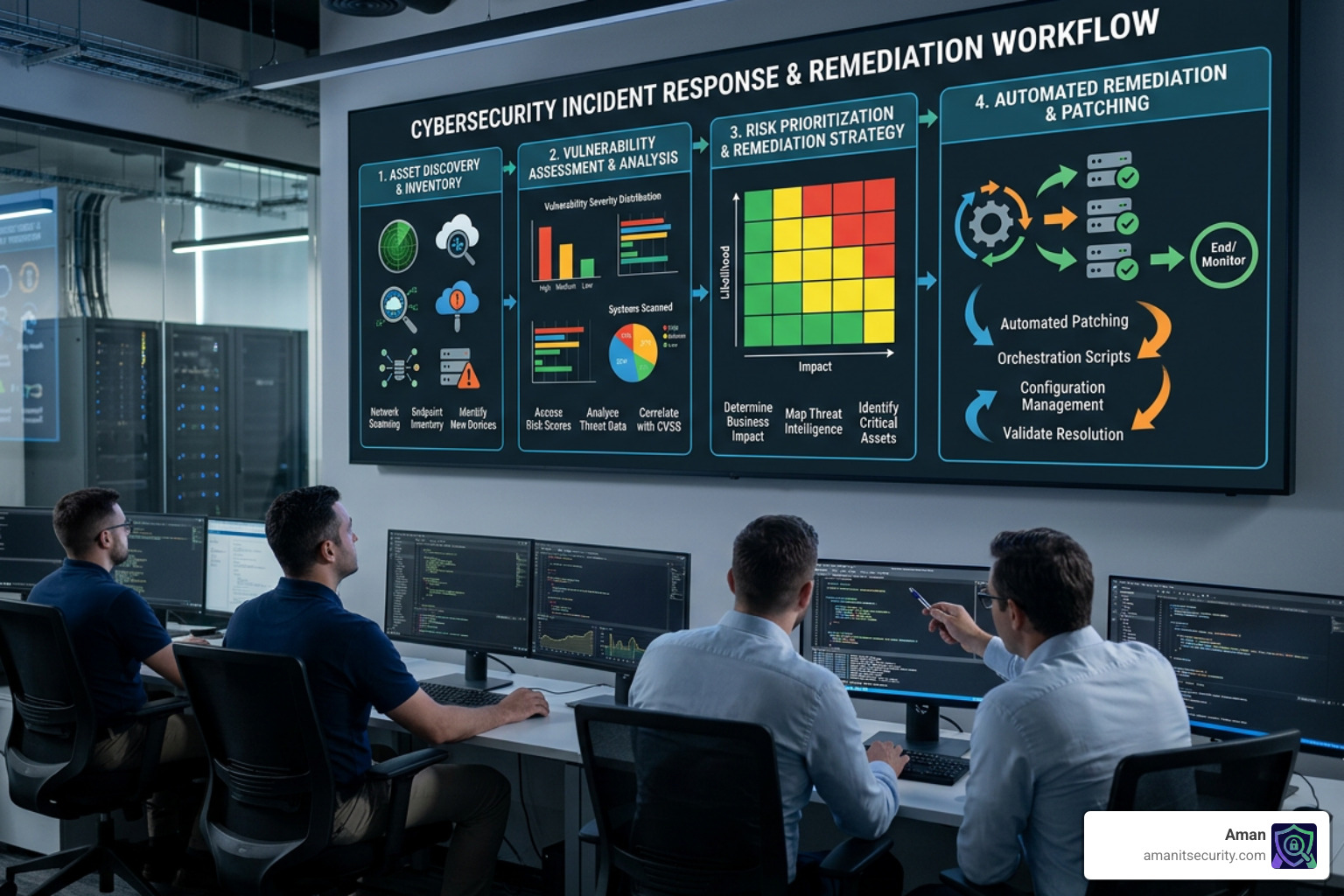
| Feature | Manual Vulnerability Management | Automated Vulnerability Management |
|---|---|---|
| Discovery | Periodic, manual asset lists | Continuous, real-time asset discovery |
| Prioritization | Based on CVSS scores only | Based on risk, threat intel, and context |
| Remediation | Manual ticketing and email chains | Automated patching and ITSM integration |
| Validation | Assuming it’s fixed until next scan | Instant rescan and telemetry confirmation |
| Speed | Weeks or months | Hours or days |
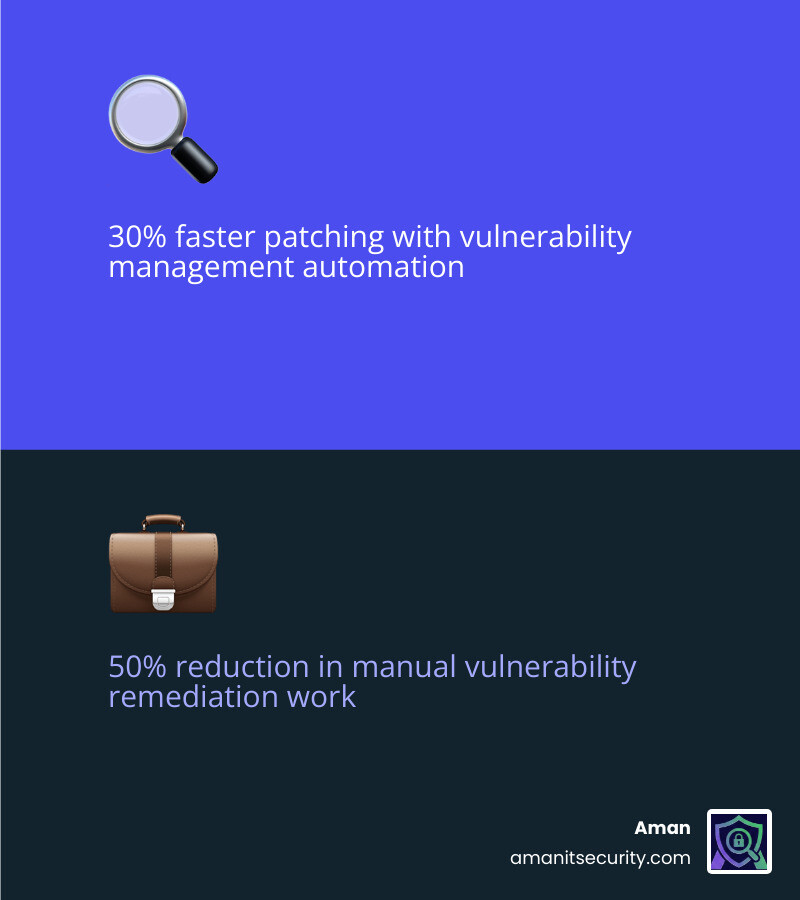
Implementing vulnerability assessment automation allows teams to report 30% faster critical vulnerability patching compared to manual processes.
How security teams leverage vulnerability management platforms for discovery
You cannot protect what you cannot see. Modern platforms use several methods to ensure 100% visibility:
- Attack Surface Management (ASM): Continuously monitors the internet for any assets belonging to your organization, including “Shadow IT” (systems spun up by departments without IT’s knowledge).
- Cloud Connectors: These plug directly into AWS, Azure, or Google Cloud to see ephemeral assets—like containers or serverless functions—that may only exist for a few minutes.
- Passive Sensors: These listen to network traffic to identify devices that don’t like being scanned, such as industrial IoT or medical equipment.
When performing these discoveries, it is vital to adhere to Microsoft Cloud Penetration Testing Rules of Engagement to ensure your automated testing doesn’t violate service provider terms.
How security teams leverage vulnerability management platforms for risk-based prioritization
Not all “Critical” vulnerabilities are created equal. A “9.8” score on a disconnected test server is less dangerous than a “7.0” on your primary payment gateway.
Security teams are moving away from the Common Vulnerability Scoring System (CVSS) as the sole metric. While CVSS tells you how bad a bug could be, it doesn’t tell you if anyone is actually using it. This is where effective vulnerability prioritization with DefectDojo or similar platforms comes in. They combine:
- Exploit Prediction Scoring System (EPSS): This predicts the probability that a vulnerability will be exploited in the next 30 days.
- Asset Criticality: Does this system hold customer data? Is it internet-facing?
- Reachability Analysis: Is the vulnerable code actually “reachable” by an attacker, or is it buried behind layers of firewalls and authentication?
Integrating Threat Intelligence and Attack Surface Management
One of the most powerful ways how security teams leverage vulnerability management platforms is by “thinking like a hacker.” This requires integrating threat intelligence.

Threat intelligence comes in three flavors:
- Strategic: High-level trends (e.g., “Ransomware groups are targeting the healthcare sector this month”).
- Operational: Details about specific attacks (e.g., “Group X is using this specific IP address to scan for SQL injection”).
- Tactical: Specific technical indicators (e.g., “This specific file hash is associated with a new malware strain”).
When you combine this with Attack Surface Management, you get “Unified Exposure Management.” Instead of just seeing a list of bugs, you see a map of how an attacker would move through your network. This reduces human errors by automating the correlation between a new threat and your specific vulnerabilities.
This collaboration often happens between the SOC (Security Operations Center) and the VOC (Vulnerability Operations Center). The VOC finds the holes, and the SOC monitors them until they are plugged.
Orchestrating Automated Remediation and Validation
Finding the bug is only half the battle. Fixing it—remediation—is where the real work happens. Modern platforms bridge the gap between security teams and IT teams by “orchestrating” the fix.
Stop Finding and Start Fixing
We often say security teams should stop finding and start fixing with AI security suggestions. Instead of sending a developer a 200-page report, the platform can:
- Open a Ticket: Automatically create a task in JIRA or ServiceNow with the exact fix instructions.
- Deploy a Patch: Integrate with tools like Microsoft Intune to push an update to thousands of laptops instantly.
- Apply Compensating Controls: If a patch isn’t available, the platform can automatically update firewall rules to block traffic to the vulnerable service.
The Validation Loop
A common mistake is “closing the ticket” and assuming the job is done. Automation ensures that once a patch is applied, a “Validation Scan” is triggered immediately. If the vulnerability is still there, the ticket stays open. This “closed-loop” process ensures that “fixed” actually means fixed.
Measuring Success: Metrics and ROI of Automation
How do you prove to the board that your vulnerability management platform is worth the investment? You use data.
Key metrics that demonstrate a successful program include:
- Mean Time to Detect (MTTD): How long does it take for us to notice a new vulnerability? (Goal: Minutes/Hours).
- Mean Time to Remediate (MTTR): How long from discovery to “fixed”? (Goal: Days for criticals).
- SLA Compliance: What percentage of vulnerabilities are fixed within the timeframe defined by our company policy?
- Risk Posture Improvement: A trend line showing the total “Risk Score” of the organization decreasing over time.
Following a vulnerability management lifecycle guide helps teams move from reactive “firefighting” to a predictable, measurable business process. This not only prevents breaches but significantly reduces the operational cost of the security team.
Frequently Asked Questions
What is the difference between a vulnerability and a risk?
A vulnerability is a technical flaw (like a hole in a fence). A risk is the likelihood and impact of someone actually climbing through that hole to steal something. If the hole is in a fence surrounding an empty field, the risk is low. If the hole is in a fence surrounding a gold vault, the risk is high.
How does automation reduce the “vulnerability fatigue” felt by security analysts?
Automation handles the “noise.” It suppresses false positives, deduplicates identical findings from different tools, and automatically handles low-risk tasks. This allows analysts to focus on the 2% of exposures that drive 80% of the actual risk.
Why is CVSS alone insufficient for prioritizing security patches?
CVSS is a “static” score. It doesn’t change based on whether a hacker has released an “exploit kit” on the dark web. It also doesn’t know your business. A “Medium” vulnerability on a server that controls your entire production line is much more important than a “Critical” vulnerability on a guest Wi-Fi printer.
Conclusion
At Aman Security, we believe that security shouldn’t be a bottleneck—it should be a superpower. By understanding how security teams leverage vulnerability management platforms, you can transform your security posture from a game of “Whack-a-Mole” into a streamlined, AI-driven machine.
We provide AI-powered automated penetration testing and vulnerability scanning that doesn’t just give you a list of problems—it gives you instant AI explanations and fix suggestions. The best part? You can start with our Free scans today to see exactly where you stand.
As we look toward the future, trends like XDR (Extended Detection and Response) and AI-driven autonomous remediation will continue to shape the landscape. Don’t let your organization fall behind the 15-day exploitation window. Strengthen your security posture with Aman and turn your vulnerability backlog into a roadmap for resilience.
Secure Your Apps with Aman
Put these mitigation steps into practice. Get professional-grade vulnerability detection in one place.
Launch Your First Scan Now