Top Tools for Penetration Testing Using AI to Outsmart the Bots
Top Tools for Penetration Testing Using AI to Outsmart the Bots
Why AI-Powered Penetration Testing Tools Are Changing Security in 2026
Penetration testing using AI is now one of the fastest-growing areas in cybersecurity — and for good reason.
Here are the top AI-powered pentesting tools worth evaluating in 2026:
| Tool | Best For | Key Strength |
|---|---|---|
| Aikido Attack | Web apps & APIs | Full pentest in hours, SOC2/ISO27001 reports |
| Mindgard | LLM & AI model security | Continuous red teaming via MITRE ATLAS™ |
| Garak | LLM vulnerability scanning | Open-source, plugin-based LLM probes |
| PentestGPT | Autonomous web pentesting | 228.6% performance gain over baseline |
| NetSPI | Enterprise PTaaS | Hybrid human-AI, cloud & network coverage |
| Cobalt.io | Agile pentesting | Fast start, human-AI collaboration |
| Nessus | Vulnerability scanning | Broad coverage, compliance reporting |
Traditional pentesting is slow. Scheduling takes weeks. Reports arrive even later. Meanwhile, your attack surface keeps growing — especially if you’re shipping AI-powered features.
AI changes this equation dramatically. Hundreds of autonomous agents can now scan, exploit, and validate vulnerabilities in hours, not weeks. One real-world example: a 120-hour human pentest found zero issues, while a 2-hour AI pentest uncovered multiple high-severity vulnerabilities in the same application.
That kind of gap is hard to ignore.
This guide breaks down the best tools available, how they work, what vulnerabilities they catch, and how to pick the right one for your team.
I’m Zezo Hafez, an IT Manager and cloud architect with 15+ years of web development and infrastructure experience — I’ve seen how penetration testing using AI is reshaping how teams secure applications at scale. The sections below reflect that hands-on perspective, so you can cut through the hype and focus on what actually works.
What is Penetration Testing Using AI?
At its core, penetration testing using AI is the application of machine learning, large language models (LLMs), and autonomous agents to the practice of ethical hacking. While traditional pentesting relies on a human expert manually running scripts and poking at edge cases, AI-driven testing uses “agentic” workflows. These are systems where a central “brain” (the AI) coordinates hundreds of specialized sub-agents to perform reconnaissance, identify flaws, and attempt exploits simultaneously.
The difference in performance is staggering. Research indicates that AI-powered platforms can achieve an 88% alert reduction compared to traditional automated scanners. This is because AI doesn’t just flag a potential issue; it attempts to validate it. If the AI can’t actually exploit the flaw, it doesn’t bother you with a notification.
Furthermore, we are seeing a massive shift in speed. AI agents can work in parallel to discover and exploit vulnerabilities up to 80x faster than manual efforts. This allows for continuous monitoring rather than the “once-a-year” audit model. In modern DevSecOps, the role automated security tools play is shifting from simple scanners to proactive, autonomous defenders that scale alongside your cloud infrastructure. Recent academic papers, such as Multi-Agent Penetration Testing AI for the Web, highlight how these systems use reasoning modules to chain together small vulnerabilities into a significant “kill chain” that a human might miss.
Unique Vulnerabilities in AI and LLM Systems
As we integrate more AI into our own products, we create a new “attack surface.” You can’t just use a standard web scanner to find flaws in a chatbot. These systems require specialized testing for vulnerabilities that didn’t exist five years ago.
- Prompt Injection: This is the most common flaw, where an attacker “tricks” an LLM into ignoring its safety instructions. It’s essentially the SQL injection of the AI world.
- Data Poisoning: If an attacker can influence the data used to train or fine-tune your model, they can create “backdoors” that allow them to bypass security later.
- Model Inversion and Extraction: These attacks involve querying the AI to “leak” the private data it was trained on or to reconstruct the proprietary model itself.
- Adversarial Attacks: These are subtle modifications—like imperceptible pixel changes in an image—that cause an AI to completely misclassify an input.
To combat these, we look toward frameworks like the OWASP Top 10 for LLMs and the MITRE ATLAS™ framework. These provide a roadmap for what to test. If you’re wondering where to start, check out our guide on 3 AI security audit tools that will not make you nap to see how modern tools handle these complex business logic errors.
Top AI-Powered Pentesting Tools for 2026
Choosing the right tool depends on whether you are testing your internal network, a web application, or the AI models themselves.

For a deeper dive into the technical side of selection, see the ultimate guide to choosing an ai sast analysis tool.
Mindgard and Garak for LLM Security
When it comes to securing the actual AI models, Mindgard and Garak are the frontrunners.
Mindgard is built specifically for “red teaming” AI. It uses a MITRE ATLAS™ Adviser to run structured, adversarial tests against your models. It’s designed to be put on “autopilot,” continuously testing for zero-day weaknesses and providing automated reporting that is actually readable for developers.
Garak, on the other hand, is a fantastic open-source vulnerability scanner for LLMs. It works by using hundreds of “probes” (essentially mini-attacks) to see if your LLM will break, hallucinate, or leak data. Because it’s plugin-based, the community is constantly adding new ways to test for the latest prompt injection techniques. Using these tools for penetration testing using AI ensures that your “smart” features aren’t actually a wide-open door for hackers.
PentestGPT and Aikido Attack for Web Apps
For those focused on securing web applications and APIs, PentestGPT and Aikido Attack are game-changers.
PentestGPT is an open-source research project that has gained massive traction. It uses an autonomous reasoning engine to “think” like a hacker. In benchmarks, it showed a 228.6% performance gain over standard LLMs by being able to chain together complex attack steps. It’s particularly good at web applications penetration testing because it doesn’t just find a bug; it reasons through how to exploit it.
Aikido Attack focuses on speed and compliance. It uses autonomous agents that perform whitebox, greybox, and blackbox testing. One of its standout features is “exploit validation”—it won’t report a vulnerability unless it can prove it exists by safely executing a PoC (Proof of Concept). This eliminates the “crying wolf” problem of traditional scanners.
Enterprise Solutions: NetSPI, Cobalt, and Nessus
For larger organizations that need a “Pentest-as-a-Service” (PTaaS) model, NetSPI and Cobalt offer hybrid approaches. They combine AI-powered scanning with human expertise.
These platforms often integrate with classic tools like Wireshark for network analysis, Metasploit for exploit execution, and Nmap for reconnaissance. Nessus remains a staple for broad infrastructure coverage, now using AI to better prioritize which of the thousands of vulnerabilities it finds are actually “reachable” and dangerous.
The Process of Conducting an AI Penetration Test
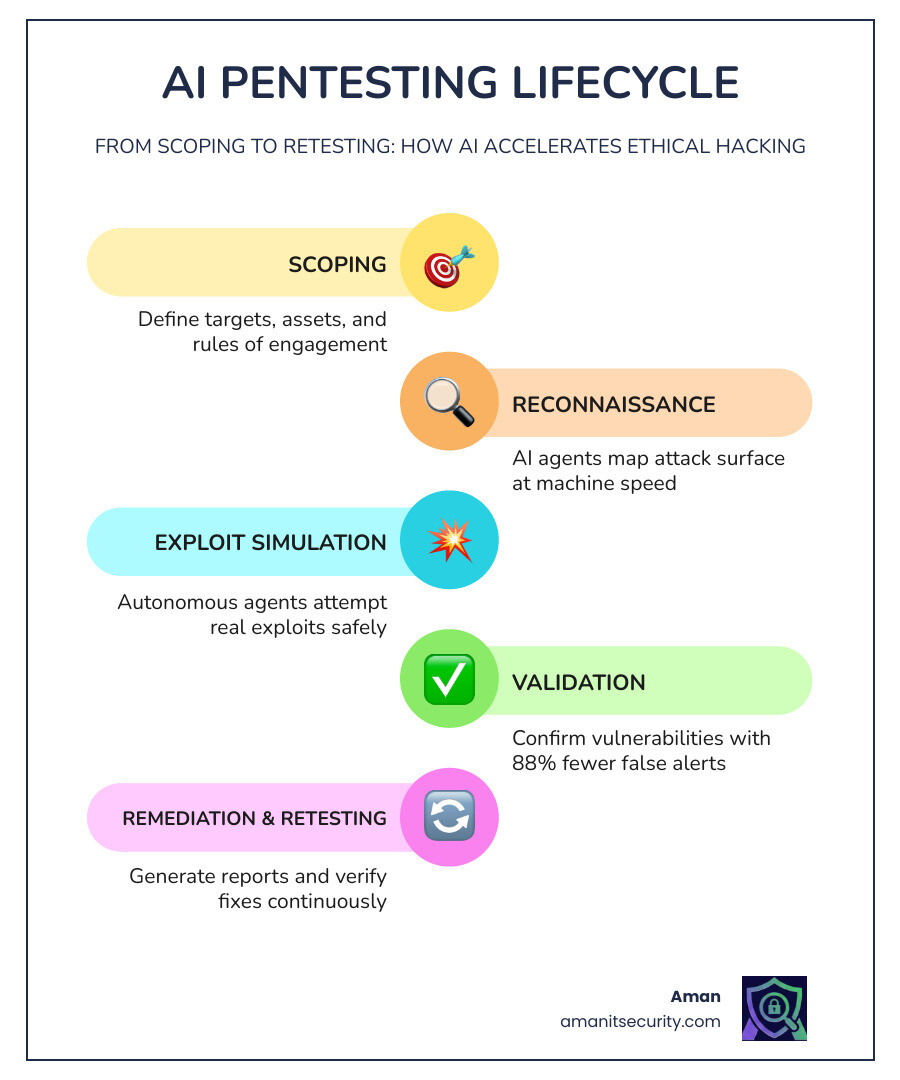
Conducting an AI-driven test follows a similar lifecycle to traditional testing, but at a much higher velocity.
- Scoping: Defining what is being tested (IPs, URLs, or AI Models) and setting safety guardrails.
- Reconnaissance: AI agents swarm the target to map the attack surface. They look at code patterns, API endpoints, and infrastructure configurations.
- Vulnerability Discovery: The AI identifies potential flaws like outdated software (e.g., finding an old PHP 5.4.1 version) or misconfigured access controls.
- Exploit Simulation: This is where the magic happens. The AI attempts to “exploit” the finding. If it finds a way in, it records the exact steps.
- Validation & Reporting: The system generates an example PDF report that is audit-ready for SOC2 or ISO/IEC 42001 compliance.
- Remediation & Retesting: Developers apply the suggested fixes, and the AI retests the specific path instantly to confirm the hole is plugged.
Frequently Asked Questions about AI Pentesting
Can AI completely replace human penetration testers?
In our experience, not entirely. While AI is 80x faster at finding “low-hanging fruit” and known vulnerabilities, it still struggles with high-level business logic. A human tester understands why a certain workflow is sensitive in a way an AI might not. We view AI as a force multiplier—it handles the “grunt work” of scanning and exploit validation, allowing human experts to focus on the creative, complex attack chains. It’s an augmentation, not a replacement.
How often should organizations conduct AI penetration testing?
Because AI testing is so cost-effective and fast, the old “annual pentest” is dead. We recommend quarterly testing at a minimum. However, for teams with rapid deployment cycles, integrating AI pentesting into the CI/CD pipeline allows for continuous testing. Every time you ship a major code change, the bots should be poking at it before a hacker does.
What are the main limitations of AI pentesting tools?
The biggest hurdles are hallucinations and production safety. An AI might “hallucinate” an exploit that doesn’t exist, leading to a false positive (though tools with validation layers solve this). More importantly, an unguided AI agent could accidentally crash a production database if not given strict “rules of engagement.” There is also a lack of standardized frameworks; while ISO/IEC 42001 is a great start, the industry is still catching up to the speed of AI evolution.
Conclusion
The era of waiting three weeks for a security report is over. Penetration testing using AI allows us to find vulnerabilities in hours, validate them with machine precision, and fix them before they can be exploited by malicious actors. At Aman Security, we believe in this human-AI synergy. By combining the blazing-fast speed of automated agents with the strategic oversight of security pros, we can build a proactive defense that actually outsmarts the bots.
Ready to see where your vulnerabilities are hiding? You can get started with Aman Security today for free and experience the future of autonomous defense.
Secure Your Apps with Aman
Put these mitigation steps into practice. Get professional-grade vulnerability detection in one place.
Launch Your First Scan Now