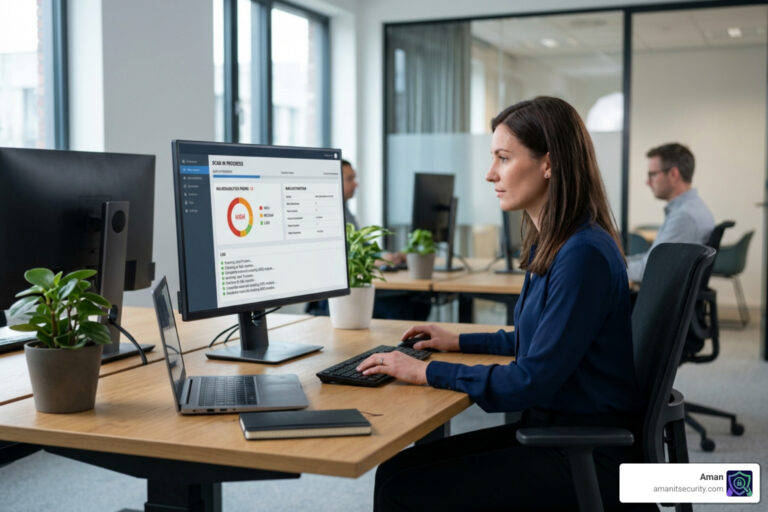
The Essential Guide to Modern Compliance Reporting Solutions
The Essential Guide to Modern Compliance Reporting Solutions
Why Every Modern Organization Needs a Compliance Reporting Tool
A compliance reporting tool is software that centralizes, automates, and streamlines how organizations track regulatory requirements, collect evidence, and prepare for audits — replacing scattered spreadsheets and manual processes with a single source of truth.
Here’s a quick breakdown of what these tools do:
| Feature | What It Means for You |
|---|---|
| Centralized evidence collection | All compliance data in one place, no more chasing files |
| Automated monitoring | Continuous checks instead of periodic manual reviews |
| Multi-framework support | SOC 2, ISO 27001, PCI DSS, HIPAA, GDPR — covered |
| Audit-ready reports | Generate reports in minutes, not weeks |
| Real-time dashboards | Instant visibility into compliance status across your org |
Compliance used to mean folders, spreadsheets, and frantic email chains before an audit. That approach breaks down fast. Regulations change. Evidence goes missing. Deadlines get missed. Fines follow.
The stakes are real. With over 78% of production workloads now running as containers or serverless applications, cloud compliance gaps are easier to miss and harder to fix manually.
Modern compliance reporting tools fix this by automating up to 90% of the work required for frameworks like SOC 2 — turning what used to take a year of manual effort into a matter of weeks.
Whether you’re a DevSecOps engineer racing toward your first SOC 2 audit or a security analyst managing multiple frameworks at once, the right tool makes the difference between reactive firefighting and proactive control.
I’m Zezo Hafez, an AWS and Azure certified IT manager with over 15 years of experience in cloud infrastructure and digital transformation — including hands-on work with compliance reporting tool implementations across complex, multi-cloud environments. In this guide, I’ll walk you through everything you need to choose the right solution for your team.
What is a Compliance Reporting Tool and Why is it Essential?
At its core, a compliance reporting tool is a centralized platform designed to ensure an organization adheres to industry regulations, legal requirements, and internal policies. Think of it as the “brain” of your governance, risk, and compliance (GRC) strategy. Instead of having your security policies in a PDF, your asset list in Excel, and your employee training records in an HR portal, these tools pull everything into one view.
Why is this essential now? The digital landscape has moved faster than manual tracking can handle. Cloud compliance is no longer a “once-a-year” event; it’s a continuous requirement. With 78% of production workloads deployed as containers or serverless applications, the sheer volume of ephemeral assets means that a manual audit is outdated the moment it’s finished.
These tools provide:
- Risk Mitigation: Identifying gaps before a regulator does.
- Data Integrity: Ensuring that the evidence you provide to an auditor is accurate and hasn’t been tampered with.
- Governance: Clearly defining who owns which control and when it was last verified.
Without a dedicated tool, you are essentially playing a game of “compliance whack-a-mole,” where fixing one issue often leads to missing another because of a lack of visibility.
Key Features to Look for in Modern Solutions
When we evaluate a compliance reporting tool, we aren’t just looking for a place to upload files. We need a system that actively works for us.
Core Features to Demand:
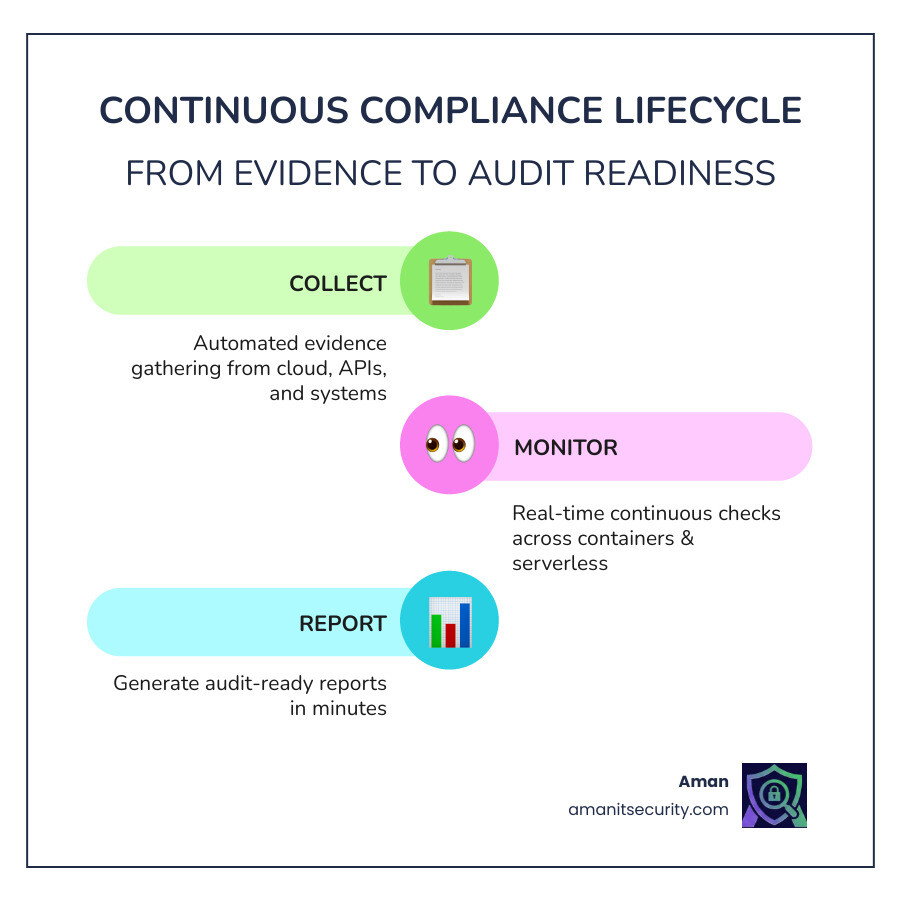
- Automated Evidence Collection: The tool should connect directly to your tech stack (AWS, Google Cloud, GitHub) to prove that encryption is on or that MFA is enabled.
- Policy Management: A library of templates that you can map to specific controls.
- Task Assignment & Smart Alerts: If a background check expires or a database becomes publicly accessible, the system should slap you (metaphorically) with an alert.
- Multi-Framework Support: You might start with SOC 2, but eventually, you’ll need ISO 27001, PCI DSS, HIPAA, or GDPR. The best tools allow you to map one piece of evidence to multiple frameworks.
Understanding the role of automated security tools is vital here. A reporting tool is only as good as the data it receives. By integrating with scanners and monitors, the tool transforms raw security data into “audit-ready” language.
Automating Evidence with a Compliance Reporting Tool
The “magic” of modern solutions lies in API integrations. By connecting to your AWS environment or your GitHub repositories, the tool can perform continuous monitoring. For example, it can verify that all your S3 buckets are private and automatically log that as evidence for your auditor.
Some platforms even offer one-click compliance reports, allowing you to export a full vulnerability summary directly into your compliance dashboard. This eliminates the manual “screenshotting” phase of an audit, which we all know is the most soul-crushing part of the job.
Addressing Common Pain Points with a Compliance Reporting Tool
The biggest enemy of a security officer isn’t a hacker; it’s a spreadsheet named Compliance_Final_v2_USE_THIS_ONE.xlsx. Spreadsheets fail because they lack ownership clarity, version control, and real-time updates.
By moving to a dedicated platform, we see:
- Spreadsheet Elimination: No more broken formulas or lost files.
- Time Savings: Automation can reduce the workload by hundreds of hours.
- Cost Reduction: Avoiding fines and reducing the billable hours of external auditors.
If you are feeling the weight of manual tracking, checking out the no-stress guide to vulnerability assessment automation can help you understand how to offload the technical heavy lifting.
Comparing Top Compliance Reporting Tools in 2025
Choosing a tool depends heavily on your company size and specific industry. Here is how the market leaders currently stack up:
| Tool | Best For | Key Strength | Automation Level |
|---|---|---|---|
| Drata | Mid-market to Enterprise | Massive integration library (75+) | Very High |
| Vanta | Startups & SaaS | Fast SOC 2 path; market pioneer | Very High |
| VComply | Governance-heavy orgs | 30-day rapid implementation | High |
| AuditBoard | Fortune 500 / Large Corp | Connected risk & ESG integration | High |
When looking at customer reviews and ratings, users consistently praise tools that offer “clean” interfaces and “auditor portals,” which allow external auditors to log in and view evidence without you having to email them a single file.
Drata and Vanta: Leaders in Automation
These two platforms have revolutionized the space by focusing on the “SaaS-native” company. They focus heavily on SOC 2 and can automate up to 90% of the manual work. Their strength lies in their ability to map evidence automatically—if you fix a bug in GitHub, Drata knows and marks the control as “passed.”
The integration between compliance platforms and automated security scanners is a great example of this ecosystem. When a scanner finds a flaw and you fix it, the report can be sent with one click to the compliance tool to satisfy your continuous monitoring requirements.
Specialized Compliance Reporting Tool Options for Enterprise
For larger organizations or those in high-stakes finance, tools like AuditBoard and VComply offer deeper GRC alignment. They don’t just look at security; they look at enterprise risk, software licensing, and even ESG (Environmental, Social, and Governance) reporting.
In the financial sector, where monitoring trillions in assets is the norm, tools often include native capture of communications (like WhatsApp or iMessage) to satisfy strict regulatory regimes. For those looking for cutting-edge help, there are 3 AI Security Audit Tools that are currently changing how internal audits are performed by using AI to spot anomalies in massive datasets.
The Role of AI and Future Trends in Compliance
We are entering the era of the “AI Compliance Agent.” The future isn’t just a dashboard that shows you what’s wrong; it’s a system that helps you fix it.
Key trends we are watching:
- Predictive Risk: AI that looks at your current deployment patterns and predicts which regulations you might be about to violate.
- Policy as Code (PaC): Instead of a written policy saying “databases must be encrypted,” the code itself prevents a non-encrypted database from ever being deployed.
- Automated Remediation: We are moving toward a world where you can stop finding and start fixing with AI. If a tool finds a missing patch, it doesn’t just report it; it suggests the exact code fix to resolve it.
This shift from “reactive reporting” to “proactive fixing” is the biggest leap in compliance history. It allows security teams to focus on strategy rather than chasing developers for screenshots.
Frequently Asked Questions about Compliance Reporting
How do these tools replace manual spreadsheets?
They replace spreadsheets by creating direct API connections to your data sources. Instead of you typing “Yes, we have a firewall” into a cell, the tool queries your cloud provider, sees the firewall, and attaches a timestamped configuration log as proof. It also handles version control automatically, so you’re never looking at an old version of a policy.
Which frameworks do the best tools support?
The top-tier tools support all major global frameworks, including SOC 2, ISO 27001, HIPAA (Healthcare), PCI DSS (Payments), GDPR (Privacy), and even specialized ones like FedRAMP or CMMC for government contractors.
What is the typical implementation timeline for these tools?
For a startup using a tool like Vanta or Drata, you can be up and running in a few days, with full “audit readiness” achieved in 4–8 weeks. For larger enterprises with complex legacy systems, a structured rollout usually takes about 30 days for the initial setup and 3–6 months for full program orchestration.
Conclusion
The era of manual compliance is over. In a world of serverless functions and instant global deployments, a compliance reporting tool is the only way to maintain trust with your customers and regulators without burning out your security team.
At Aman Security, we believe that compliance should be a byproduct of good security, not a hurdle. We provide AI-powered automated penetration testing, SAST analysis, and vulnerability scanning that integrates seamlessly into your compliance workflow. Our mission is to provide blazing-fast, comprehensive scans that don’t just find problems but offer instant AI explanations and fix suggestions.
By combining a robust reporting tool with automated security testing, you can achieve a state of “continuous audit readiness.” You’ll have the pro reports you need to close big deals and the peace of mind that your infrastructure is actually secure—not just “compliant on paper.”
Ready to automate your technical controls and simplify your next audit? Secure your infrastructure with Aman Security and get started with our free tools today.
Secure Your Apps with Aman
Put these mitigation steps into practice. Get professional-grade vulnerability detection in one place.
Launch Your First Scan Now